Don’t tell me the moon is shining; show me the glint of light on broken glass.
~~Anton Chekhov
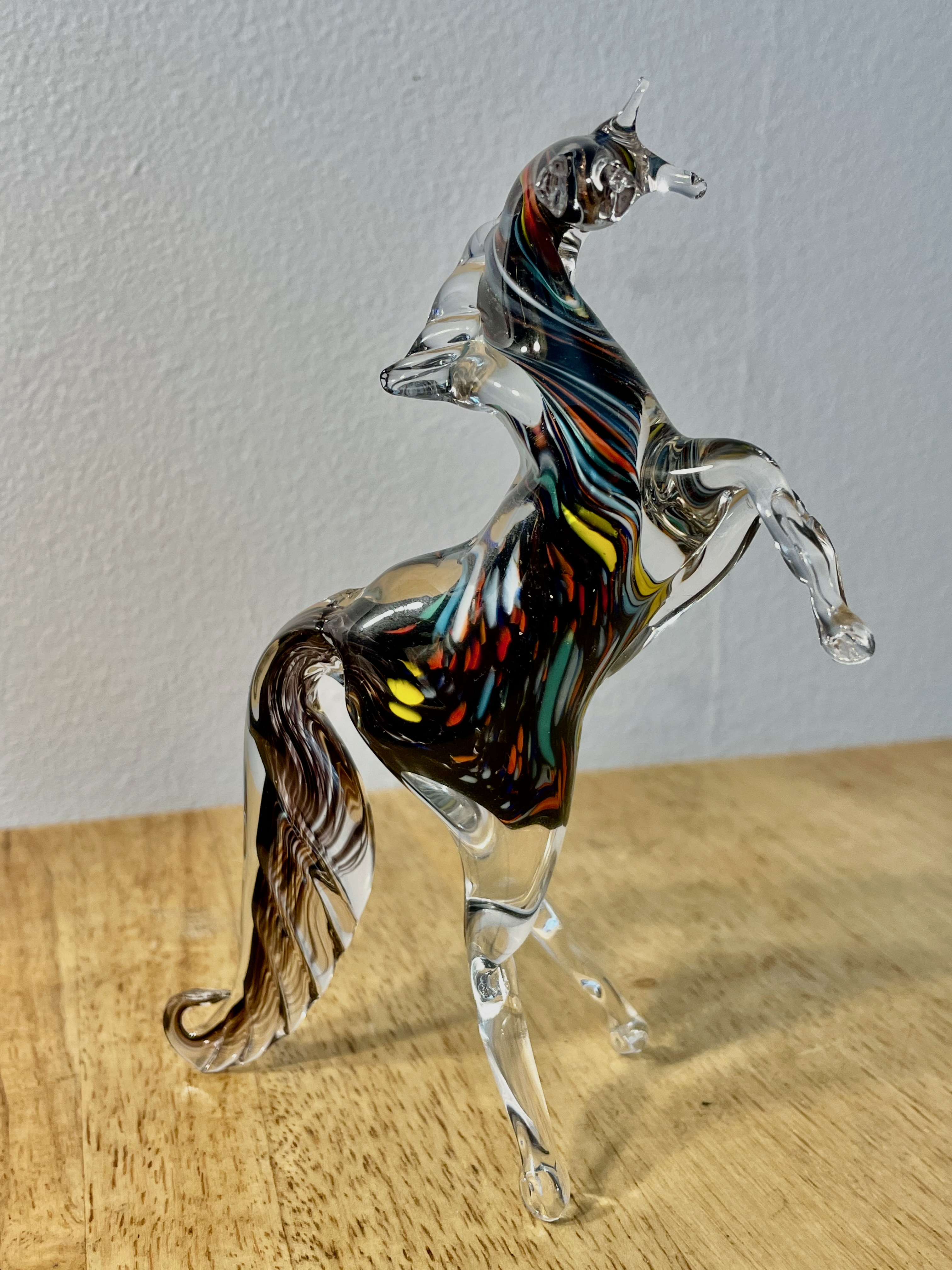
[Our glass horse from Murano, Italy. Photo is mine.]
Sometime in the ancient distant foggy and shadowy history of human existence, someone discovered how to make glass. This is thought to have occurred around 4,000 years ago. I don’t have the month or day, but I’ll check on that and get back to you later. This happened, of course in Mesopotamia, in the land between the Tigris and Euphrates Rivers. (Interestingly, the fabled location of the Garden of Eden, but that’s for another story.) It was here that the earliest evidence of proper glass making is found. I’ve often wondered how these things happen. How did a civilization have individuals that found out that by melting sand one can make a substance as fascinating as glass? It truly boggles the mind. At least my mind.
When I was a child, my parents drove from Owego to Corning, NY. This was the home of the Corning Glass Works. I sat with eyes wide from amazement while the glassblowers performed for the crowd. Their cheeks would inflate like Louis Armstrong as they blew through the Blowpipe into a glob of molten silica, soda ash and lime to produce astounding pieces of art. It awed me then and it amazes me now, still.
On a recent trip to Europe, I finally got to visit Italy. We stayed several days in Venice, a city I could probably write a book about. It is an awesome place by any standards. One of Mariam’s goals was to visit an island about forty-five minutes from St. Mark’s Piazza. We were going to Murano. I confess I didn’t know the significance that this tiny island has in the world of art glass. Stepping off the small boat we were escorted into a hall about the size of a high school gym, maybe a bit smaller. There I sat, again transfixed like my old child self, and watched something almost miraculous occur. A glob of melted sand was being heated to about 3,000℉ (when the furnace was open, I could feel the heat from thirty feet away) and slowly transformed into a horse, on its hind legs, rearing up like Trigger. I saw it all with my own two eyes. How did this craftsman do this? I looked at his hands for burn scars. Nothing. We bought one or two pieces in the gift shop. It sits in our apartment, on a sturdy bookcase. I can see it as I write this. I wanted to name him (I assume its a him but it really doesn’t matter) Lucifer. Not for any religious reason except for the fact that he was born and formed in the hottest furnace I’ve ever been near. Born of fire. Please don’t bring up The Game of Thrones…”A Song of Fire and Ice”…it’s not a reference I care to pursue.

[A recently completed bowl in the glassblowers shop. Murano. Photo is mine.]
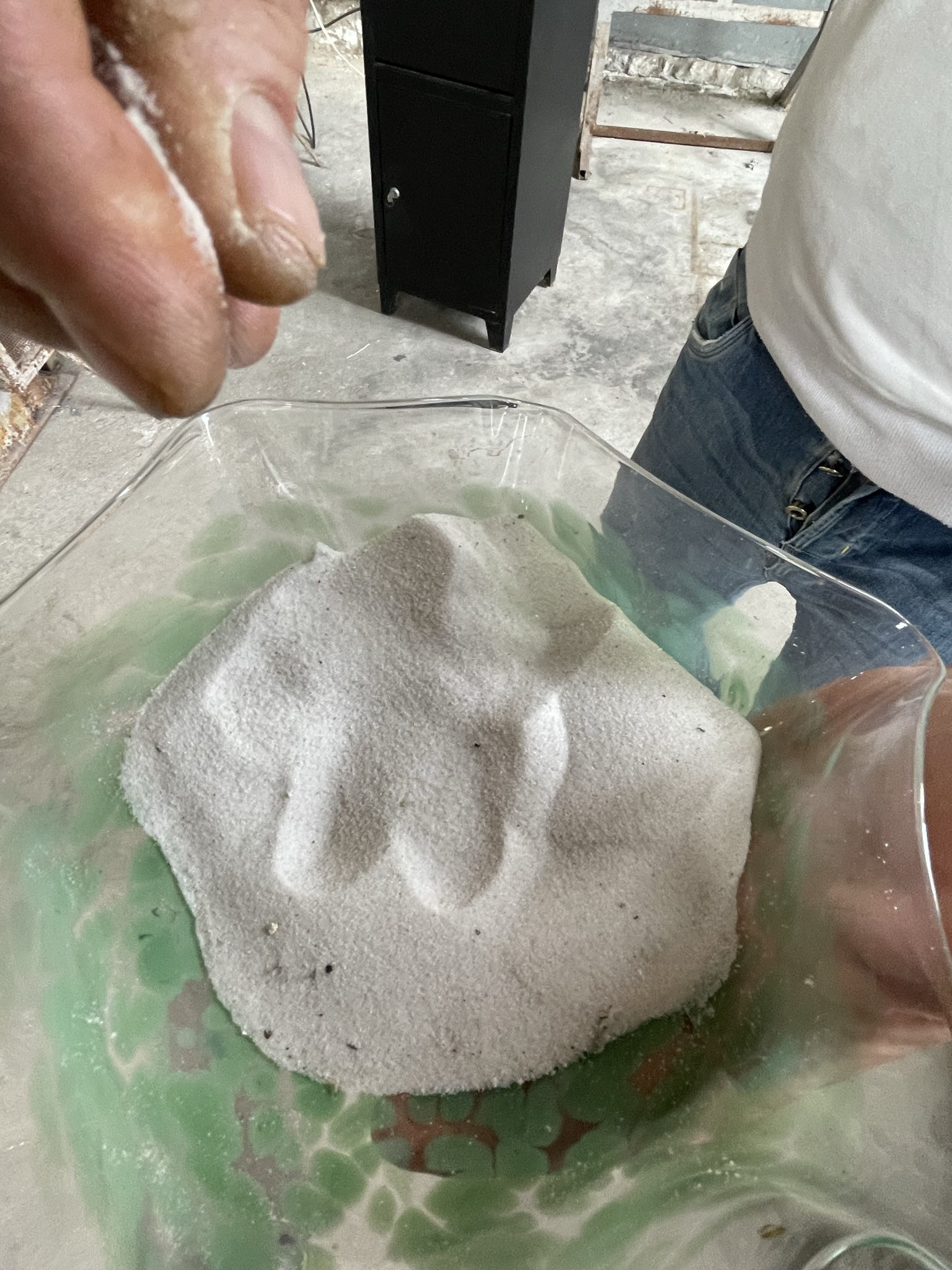
[The glass maker’s very pure silica sand. Photo is mine.]
On the boat ride back to Venice, I found myself thinking of glass and my interest in its nature. As a long-time Earth Science teacher, I knew that glass can occur in nature. But, you may well ask, can nature achieve the necessary high temperatures? Volcanoes? No way. Molten lava has a temperature range of 700℉ to 1,200℉, almost cold enough to handle. That was a joke. Don’t try that without an adult nearby!
So where in nature can silica (sand) melt? Well, on a beach. On a beach when lightening strikes. The heat will fuse the quartz sand into globules called fulgurite. That is a bit oversimplified but for this blogs purpose, let’s go with it. This is not to be confused with “Beach Glass”. That is merely a product of some ya-hoo’s discarded broken bottle of Pabst Blue Ribbon that has been tumbled by the sand and surf for awhile.
I also recall visiting The Old Manse in Concord, MA near the North Bridge. It was the home of Ralph Waldo Emerson, built by his grandfather, Rev. William Emerson. Hawthorn and other Transcendentalists often gathered there to hold lofty discussions about philosophy and religion. You know, like a dated version of Starbucks. When newlyweds Nathanial Hawthorn and his wife, Sophia lived there, they would etch poems onto a window or two. These are still visible today.

[A Hawthorn poem on a window in the Old Manse. Photo is copyrighted by Alamy.]
One of the poems:
Man’s accidents are God’s purposes.
The smallest twig leans clear against the sky.
~~Sophia Hawthorn, 1843
All very lovely and poignant, I must say. I stood in the room with the window shown in the photo. I studied the etchings. I felt the glass (when the guard wasn’t looking). I was seeking the ripples at the bottom. I had read or heard somewhere that glass is not really a solid, rather a very slowly moving liquid. Sorry, but that, I found out, is an Urban Legend.
I’ll end here with another short quote. It’s an oblique reference to glass:
Just tonight I stood before the tavern
Nothing seemed the way it used to be
In the glass I saw a strange reflection
Was that lonely person really me?
~~”Those Were The Days” by Gene Raskin
A reflection? A mirror. Now I have something more to think about…
{Note: Most of the facts presented here are from a Goggle search.}
 patrickjegan